Inflation Calculator: What Money Will Be Worth
Type any amount and a number of years to see both sides of inflation at once: what the same basket of goods will cost later, and what today’s money will actually buy when that later arrives.
How to use this calculator
Run the numbers once, write the result where you will see it, and let the free expense tracker do the weekly work: it sorts every entry into needs, wants and savings automatically, so drift from the plan is visible the moment it starts instead of at the end of the month. A calculator sets the target; tracking is what actually gets you there.
Two directions, one piece of math
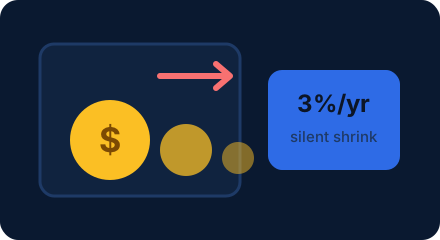
At 3% inflation, a $100 grocery run costs about $243 in thirty years — that is the future-cost direction, prices compounding forward. The same math run backwards says today’s $100 will spend like $41 when those thirty years are up — that is purchasing power, the direction people forget. Both rows come from the same compounding, which is why the calculator shows them together: the price of everything going up and the value of savings quietly going down are not two problems, they are one.
Why 3% is the default
Three percent is the rough long-run average of US consumer inflation across the last century — individual decades swing far wider, but planning numbers need a level, not a forecast. A useful shortcut falls out of it: at 3%, prices double about every twenty-four years (the rule of 72: divide 72 by the rate). That means a thirty-year-old planning retirement at sixty-five should expect to buy everything at roughly double today’s stickers, and the calculator makes that abstract doubling concrete in dollars.
What it means for the savings account
Real return is the rate your bank pays minus the rate prices rise. A legacy account paying 0.1% during 3% inflation loses about 2.9% of its purchasing power every year — the balance never shrinks, which is what makes the loss invisible. This is the entire case for high-yield savings and, for money beyond a few years out, broad investing: the goal is not a big number, it is a number that still buys what the original number did.
Raises, rents and the silent pay cut
A 2% raise during 3% inflation is a 1% pay cut in what the salary buys — the number on the stub went up while the life it funds went down. The same logic prices long-term contracts: a rent frozen for five years gets steadily cheaper in real terms, and a salary that never moves gets steadily more expensive to keep. When you negotiate, the inflation row of this calculator is the baseline the first offer has to clear just to be a raise.
Frequently asked questions
Is 3% right for recent years?
Recent years ran hotter — which is exactly why the rate field is editable. Use 3% for long-horizon planning, and your own expected rate for short horizons; either way both rows move together.
What if inflation turns negative?
Falling prices sound like a gift and mostly are not: deflation historically arrives with layoffs and makes debts heavier in real terms. It has been rare enough that planning around it is not a thing — plan on positive inflation.
Does this change my emergency-fund target?
Yes, slowly: a fund sized today at six months of expenses should be re-topped as your expenses inflate, or three years from now it quietly covers four. Run this calculator on your fund size every year or two.