Hourly to Salary Calculator (Both Directions)
Convert an hourly rate into yearly, monthly, biweekly and weekly pay — or run it backwards from a salary offer to the hourly rate it really is. Hours per week is yours to set.
How to use this calculator
Run the numbers once, write the result where you will see it, and let the free expense tracker do the weekly work: it sorts every entry into needs, wants and savings automatically, so drift from the plan is visible the moment it starts instead of at the end of the month. A calculator sets the target; tracking is what actually gets you there.
The standard math, with its three assumptions
Hourly rate times hours per week times 52 is the whole formula — $25 an hour at 40 hours is $52,000 a year. The formula quietly assumes you work all 52 weeks: no vacation, no sick days, no unpaid gaps. Hourly workers paid only for hours worked should either drop a week or two from the multiplier or accept the number as a ceiling. Salaried people converting in reverse get the cleaner deal: the salary is paid whether or not the week had a holiday in it.
Running it backwards on a job offer
Type the annual number and leave hourly blank: $52,000 at 40 hours a week is exactly $25 an hour. That single conversion reframes everything — the $900 monthly car payment is 36 hours of your life, the Friday takeaway is half an hour. It is also the honest way to compare a salaried offer against freelance work: the freelancer charging $25 an hour is not the financial equal of a $25-an-hour employee, because the freelancer buys their own insurance, pays both halves of payroll tax, and works unpaid hours quoting and invoicing that never reach an invoice.
What the gross number leaves out
Every figure here is gross — before federal and state tax, before the insurance premium, before the 401(k) deduction. Budget on take-home, not on this number: the gap between the two is typically 20 to 30 percent, which is why the paycheck budgeter on this site starts from what actually lands in the account. A useful habit: convert any raise to its monthly after-tax reality before spending it — $4,000 a year more is about $260 a month, not $333.
Overtime and the side gig
Overtime at time-and-a-half turns a $25 hour into $37.50 — which is why employers thin the hours when salary conversion flatters the base rate. For side income, the number that matters is the hourly rate after tax and expenses: a weekend gig paying $20 an hour with a 30-minute commute each way and your own tools can be a $13 hour, and comparing that to your salaried $25 tells you whether the gig pays or just stays busy.
Frequently asked questions
Is 2,080 hours the same calculation?
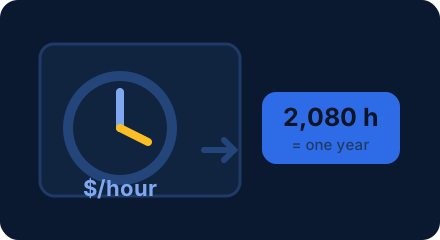
Yes — 40 hours times 52 weeks is 2,080 hours, the standard full-time year. Change the hours field for part-time or overtime-heavy schedules and the calculator follows.
How do I convert for a part-time schedule?
Enter your real weekly hours — 25 hours at $18 is $23,400 a year. The calculator never assumes full-time; the hours field is the schedule.
Hourly or salary — which is better?
Neither universally: salary buys predictability and paid time off, hourly buys paid overtime and honest clocking. Convert both to an hourly figure including benefits and compare those.